Woman Body Drawing on Newspaper Background Newspaper Art Ideas
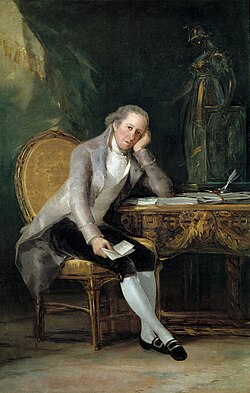 Gaspar Melchor de Jovellanos, a Spanish author depicted with the tools of the trade. | |
| Occupation | |
|---|---|
| Activity sectors | Literature |
| Description | |
| Competencies | Linguistic communication proficiency, Grammar, Literacy |
| Fields of | Mass Media, Social Media |
| Related jobs |
|
A writer is a person who uses written words in different writing styles and techniques to communicate ideas. Writers produce different forms of literary art and artistic writing such equally novels, brusk stories, books, poesy, travelogues, plays, screenplays, teleplays, songs, and essays also every bit other reports and news articles that may be of interest to the general public. Writers' texts are published across a wide range of media. Skilled writers who are able to use language to express ideas well, often contribute significantly to the cultural content of a society.[i]
The term "author" is as well used elsewhere in the arts and music – such every bit songwriter or a screenwriter – merely equally a standalone "writer" unremarkably refers to the creation of written linguistic communication. Some writers work from an oral tradition.
Writers can produce cloth across a number of genres, fictional or not-fictional. Other writers utilize multiple media – for case, graphics or illustration – to enhance the advice of their ideas. Another contempo need has been created past civil and government readers for the work of non-fictional technical writers, whose skills create understandable, interpretive documents of a applied or scientific kind. Some writers may use images (drawing, painting, graphics) or multimedia to augment their writing. In rare instances, creative writers are able to communicate their ideas via music too equally words.[2]
Equally well as producing their own written works, writers ofttimes write on how they write (their writing procedure);[iii] why they write (that is, their motivation);[iv] and also comment on the piece of work of other writers (criticism).[5] Writers work professionally or not-professionally, that is, for payment or without payment and may be paid either in advance (or on acceptance), or but after their work is published. Payment is just i of the motivations of writers and many are non paid for their piece of work.
The term writer is oftentimes used as a synonym of author, although the latter term has a somewhat broader meaning and is used to convey legal responsibility for a slice of writing, even if its composition is anonymous, unknown or collaborative.
Types [edit]

Writers choose from a range of literary genres to express their ideas. Most writing can be adapted for utilize in another medium. For instance, a writer'south work may be read privately or recited or performed in a play or pic. Satire for example, may be written as a verse form, an essay, a motion picture, a comic play, or a office of journalism. The author of a letter may include elements of criticism, biography, or journalism.
Many writers work across genres. The genre sets the parameters merely all kinds of artistic adaptation have been attempted: novel to film; poem to play; history to musical. Writers may brainstorm their career in one genre and change to another. For example, historian William Dalrymple began in the genre of travel literature and also writes as a journalist. Many writers accept produced both fiction and non-fiction works and others write in a genre that crosses the two. For example, writers of historical romances, such as Georgette Heyer, create characters and stories set up in historical periods. In this genre, the accuracy of the history and the level of factual detail in the work both tend to exist debated. Some writers write both creative fiction and serious analysis, sometimes using other names to separate their work. Dorothy Sayers, for case, wrote criminal offense fiction but was likewise a playwright, essayist, translator, and critic.
Literary and creative [edit]

Poet [edit]
I Will Write
He had done for her all that a man could,
And some might say, more than than a human being should,
And then was e'er a flame so recklessly diddled out
Or a terminal goodbye so negligent as this?
'I will write to you,' she muttered briefly,
Tilting her cheek for a polite kiss;
Then walked away, nor ever turned well-nigh. ...Long messages written and mailed in her own caput –
There are no mails in a city of the dead.Robert Graves[6]
Poets make maximum use of the language to achieve an emotional and sensory effect as well every bit a cerebral one. To create these effects, they use rhyme and rhythm and they also use the backdrop of words with a range of other techniques such as alliteration and assonance. A common topic is love and its vicissitudes. Shakespeare's best-known love story Romeo and Juliet, for example, written in a variety of poetic forms, has been performed in innumerable theaters and made into at least eight cinematic versions.[7] John Donne is some other poet renowned for his dearest poetry.
Novelist [edit]
A novelist is an writer or author of novels, though frequently novelists also write in other genres of both fiction and not-fiction. Some novelists are professional person novelists, thus make a living writing novels and other fiction, while others aspire to support themselves in this style or write as an avocation. Most novelists struggle to accept their debut novel published, but one time published they frequently go on to be published, although very few get literary celebrities, thus gaining prestige or a considerable income from their piece of work.
Every novel worthy of the name is like some other planet, whether large or small, which has its own laws just as it has its own flora and fauna. Thus, Faulkner'south technique is certainly the best i with which to paint Faulkner's earth, and Kafka'due south nightmare has produced its own myths that make information technology communicable. Benjamin Constant, Stendhal, Eugène Fromentin, Jacques Rivière, Radiguet, all used different techniques, took different liberties, and gear up themselves unlike tasks.
François Mauriac, novelist[8]
Satirist [edit]
A satirist uses wit to ridicule the shortcomings of society or individuals, with the intent of revealing stupidity. Unremarkably, the subject of the satire is a contemporary issue such every bit ineffective political decisions or politicians, although human vices such as greed are also a common and prevalent subject field. Philosopher Voltaire wrote a satire well-nigh optimism chosen Candide, which was afterward turned into an opera, and many well known lyricists wrote for it. There are elements of Absurdism in Candide, just as there are in the work of contemporary satirist Barry Humphries, who writes comic satire for his character Matriarch Edna Everage to perform on stage.
Satirists use different techniques such as irony, sarcasm, and hyperbole to make their point and they choose from the full range of genres – the satire may be in the course of prose or verse or dialogue in a film, for example. One of the virtually well-known satirists is Jonathan Swift who wrote the four-volume work Gulliver'due south Travels and many other satires, including A Modest Proposal and The Battle of the Books.
Information technology is amazing to me that ... our age is almost wholly illiterate and has hardly produced one writer upon any bailiwick.
Jonathan Swift, satirist (1704)[ix]
Short story writer [edit]
A short story writer is a writer of short stories, works of fiction that can be read in a single sitting.
Performative [edit]
Librettist [edit]
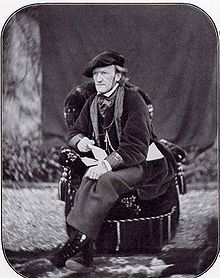
Libretti (the plural of libretto) are the texts for musical works such equally operas. The Venetian poet and librettist Lorenzo Da Ponte, for example, wrote the libretto for some of Mozart's greatest operas. Luigi Illica and Giuseppe Giacosa were Italian librettists who wrote for Giacomo Puccini. Well-nigh opera composers collaborate with a librettist only unusually, Richard Wagner wrote both the music and the libretti for his works himself.
Chi son? Sono poeta. Che cosa faccio? Scrivo. E come up vivo? Vivo. ("Who am I? I'm a poet. What do I exercise? I write. And how do I live? I live.")
Rodolpho, in Puccini'southward La bohème [10]
Lyricist [edit]
Usually writing in verses and choruses, a lyricist specializes in writing lyrics, the words that accompany or underscore a song or opera. Lyricists also write the words for songs. In the example of Tom Lehrer, these were satirical. Lyricist Noël Coward, who wrote musicals and songs such equally "Mad Dogs and Englishmen" and the recited vocal "I Went to a Marvellous Party", also wrote plays and films and performed on stage and screen likewise. Writers of lyrics, such equally these ii, adapt other writers' work as well as create entirely original parts.
Making lyrics feel natural, sit on music in such a mode that you don't feel the effort of the author, so that they shine and bubble and ascension and fall, is very, very hard to practice.
Stephen Sondheim, lyricist[eleven]
Playwright [edit]

A playwright writes plays which may or may non be performed on a stage past actors. A play'due south narrative is driven by dialogue. Similar novelists, playwrights usually explore a theme past showing how people respond to a set of circumstances. As writers, playwrights must brand the language and the dialogue succeed in terms of the characters who speak the lines also as in the play as a whole. Since almost plays are performed, rather than read privately, the playwright has to produce a text that works in spoken course and can also hold an audience's attending over the period of the performance. Plays tell "a story the audience should intendance about", and then writers have to cut anything that worked against that.[12] Plays may exist written in prose or verse. Shakespeare wrote plays in iambic pentameter as does Mike Bartlett in his play King Charles Iii (2014).[12]
Playwrights as well arrange or re-write other works, such as plays written earlier or literary works originally in some other genre. Famous playwrights such every bit Henrik Ibsen or Anton Chekhov have had their works adapted several times. The plays of early Greek playwrights Sophocles, Euripides, and Aeschylus are still performed. Adaptations of a playwright's work may be honest to the original or creatively interpreted. If the writers' purpose in re-writing the play is to brand a movie, they volition accept to ready a screenplay. Shakespeare'southward plays, for case, while even so regularly performed in the original form, are often adjusted and abridged, especially for the cinema. An example of a creative modernistic adaptation of a play that nevertheless used the original writer'south words, is Baz Luhrmann's version of Romeo and Juliet. The amendment of the name to Romeo + Juliet indicates to the audience that the version will be unlike from the original. Tom Stoppard'south play Rosencrantz and Guildenstern Are Expressionless is a play inspired past Shakespeare's Hamlet that takes two of Shakespeare'due south nigh small-scale characters and creates a new play in which they are the protagonists.
Player : It'southward what the actors practice best. They have to exploit any talent is given to them, and their talent is dying. They tin die heroically, comically, ironically, slowly, suddenly, disgustingly, charmingly or from a great superlative.
Tom Stoppard, Rosencrantz and Guildenstern Are Dead (Act 2)[xiii]
Screenwriter [edit]
Screenwriters write a screenplay – or script – that provides the words for media productions such equally films, telly series and video games. Screenwriters may start their careers by writing the screenplay speculatively; that is, they write a script with no advance payment, solicitation or contract. On the other hand, they may be employed or deputed to suit the work of a playwright or novelist or other author. Self-employed writers who are paid by contract to write are known as freelancers and screenwriters often work under this blazon of organization.
Screenwriters, playwrights and other writers are inspired by the classic themes and often use similar and familiar plot devices to explore them. For example, in Shakespeare's Hamlet is a "play within a play", which the hero uses to demonstrate the king's guilt. Hamlet hives the co-operation of the actors to fix the play as a thing "wherein I'll catch the censor of the king".[14] Teleplay author Joe Menosky deploys the aforementioned "play inside a play" device in an episode of the scientific discipline fiction television serial Star Trek: Voyager. The statuary-age playwright/hero enlists the support of a Star Expedition crew member to create a play that will convince the ruler (or "patron" as he is called), of the futility of war.[15]
Speechwriter [edit]
A speechwriter prepares the text for a speech to be given earlier a group or crowd on a specific occasion and for a specific purpose. They are ofttimes intended to exist persuasive or inspiring, such as the speeches given past skilled orators like Cicero; charismatic or influential political leaders similar Nelson Mandela; or for use in a court of law or parliament. The author of the spoken communication may be the person intended to deliver information technology, or information technology might be prepared by a person hired for the task on behalf of someone else. Such is the example when speechwriters are employed by many senior-level elected officials and executives in both regime and private sectors.
Interpretive and academic [edit]
Biographer [edit]
Biographers write an account of another person's life. Richard Ellmann (1918–1987), for example, was an eminent and award-winning biographer whose work focused on the Irish gaelic writers James Joyce, William Butler Yeats, and Oscar Wilde. For the Wilde biography, he won the 1989 Pulitzer Prize for Biography.
Critic [edit]
Critics consider and assess the extent to which a piece of work succeeds in its purpose. The work under consideration may be literary, theatrical, musical, artistic, or architectural. In assessing the success of a work, the critic takes account of why information technology was washed – for example, why a text was written, for whom, in what style, and under what circumstances. After making such an assessment, critics write and publish their evaluation, adding the value of their scholarship and thinking to substantiate any opinion. The theory of criticism is an area of study in itself: a practiced critic understands and is able to incorporate the theory backside the work they are evaluating into their assessment.[16] Some critics are already writers in another genre. For example, they might be novelists or essayists. Influential and respected writer/critics include the art critic Charles Baudelaire (1821–1867) and the literary critic James Forest (born 1965), both of whom accept books published containing collections of their criticism. Some critics are poor writers and produce only superficial or unsubstantiated work. Hence, while anyone can be an uninformed critic, the notable characteristics of a good critic are understanding, insight, and an ability to write well.
We tin can claim with at least as much accurateness as a well-known writer claims of his little books, that no newspaper would dare print what we have to say. Are we going to be very fell and abusive, then? By no means: on the contrary, we are going to be impartial. We have no friends – that is a corking thing – and no enemies.
Charles Baudelaire, introducing his Review of the Paris Salon of 1845[17]
Editor [edit]

An editor prepares literary material for publication. The cloth may exist the editor'south own original work but more commonly, an editor works with the material of one or more other people. In that location are different types of editor. Copy editors format text to a detail style and/or correct errors in grammar and spelling without irresolute the text substantively. On the other hand, an editor may propose or undertake significant changes to a text to amend its readability, sense or construction. This latter type of editor can go so far as to excise some parts of the text, add together new parts, or restructure the whole. The piece of work of editors of aboriginal texts or manuscripts or collections of works results in differing editions. For example, there are many editions of Shakespeare'due south plays by notable editors who also contribute original introductions to the resulting publication.[18] Editors who work on journals and newspapers have varying levels of responsibility for the text – they may write original fabric, in item, editorials; select what is to be included from a range of items on offering; format the material; or check its accuracy.
Encyclopaedist [edit]
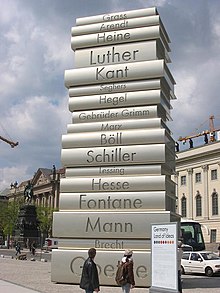
Encyclopaedists create organised bodies of knowledge. Denis Diderot (1713–1784) is renowned for his contributions to the Encyclopédie. The encyclopaedist Bernardino de Sahagún (1499–1590) was a Franciscan whose Historia general de las cosas de Nueva España is a vast encyclopedia of Mesoamerican civilization, commonly referred to as the Florentine Codex, afterwards the Italian manuscript library which holds the best-preserved copy.
Essayist [edit]
Essayists write essays, which are original pieces of writing of moderate length in which the author makes a case in back up of an opinion. They are unremarkably in prose, but some writers have used poetry to present their statement.
Historian [edit]
A historian is a person who studies and writes virtually the past and is regarded as an authority on it.[19] The purpose of a historian is to employ historical analysis to create coherent narratives that explicate "what happened" and "why or how information technology happened". Professional historians typically work in colleges and universities, archival centers, government agencies, museums, and equally freelance writers and consultants.[20] Edward Gibbon'southward 6-book History of the Turn down and Fall of the Roman Empire influenced the development of historiography.
Lexicographer [edit]
Writers who create dictionaries are called lexicographers. One of the most famous is Samuel Johnson (1709–1784), whose Lexicon of the English language Language was regarded not only as a slap-up personal scholarly achievement only was also a dictionary of such pre-eminence, that would have been referred to past such writers equally Jane Austen.
Researcher/Scholar [edit]
Researchers and scholars who write almost their discoveries and ideas sometimes have profound effects on society. Scientists and philosophers are good examples because their new ideas can revolutionise the manner people recall and how they behave. Three of the all-time known examples of such a revolutionary consequence are Nicolaus Copernicus, who wrote De revolutionibus orbium coelestium (1543); Charles Darwin, who wrote On the Origin of Species (1859); and Sigmund Freud, who wrote The Interpretation of Dreams (1899).
These iii highly influential, and initially very controversial, works inverse the way people understood their place in the world. Copernicus's heliocentric view of the creation displaced humans from their previously accepted place at the centre of the universe; Darwin'due south evolutionary theory placed humans firmly inside, equally opposed to above, the order of manner; and Freud'southward ideas most the power of the unconscious mind overcame the conventionalities that humans were consciously in control of all their ain deportment.[21]
Translator [edit]
Translators have the task of finding some equivalence in another language to a writer's meaning, intention and style. Translators whose work has had very significant cultural effect include Al-Ḥajjāj ibn Yūsuf ibn Maṭar, who translated Elements from Greek into Standard arabic and Jean-François Champollion, who deciphered Egyptian hieroglyphs with the result that he could publish the first translation of the Rosetta Stone hieroglyphs in 1822. Difficulties with translation are exacerbated when words or phrases incorporate rhymes, rhythms, or puns; or when they take connotations in one language that are non-existent in another. For case, the title of Le Grand Meaulnes by Alain-Fournier is supposedly untranslatable considering "no English language describing word volition convey all the shades of meaning that tin be read into the simple [French] word 'grand' which takes on overtones as the story progresses."[22] Translators accept too go a function of events where political figures who speak different languages encounter to look into the relations between countries or solve political conflicts. It is highly critical for the translator to evangelize the correct information as a desperate impact could exist caused if whatsoever error occurred.
Fifty-fifty if translation is impossible – we take no selection but to do it: to take the next step and first translating. ... The translator's task is to make us either forget or else enjoy the difference.
Robert Dessaix, translator, writer[23]
Reportage [edit]
Blogger [edit]
Writers of blogs, which have appeared on the World wide web since the 1990s, need no authorisation to be published. The contents of these brusk opinion pieces or "posts" form a commentary on problems of specific involvement to readers who can use the aforementioned engineering science to interact with the author, with an immediacy hitherto incommunicable. The ability to link to other sites means that some web log writers – and their writing – may become suddenly and unpredictably pop. Malala Yousafzai, a immature Pakistani educational activity activist, rose to prominence due to her weblog for BBC.
A web log writer is using the technology to create a message that is in some ways like a newsletter and in other means, like a personal letter. "The greatest difference betwixt a weblog and a photocopied school newsletter, or an annual family letter photocopied and mailed to a hundred friends, is the potential audience and the increased potential for directly communication betwixt audience members".[24] Thus, equally with other forms of messages the writer knows some of the readers, but one of the primary differences is that "some of the audience will exist random" and "that presumably changes the way we [writers] write."[24] Information technology has been argued that blogs owe a debt to Renaissance essayist Michel de Montaigne, whose Essais ("attempts"), were published in 1580, because Montaigne "wrote as if he were chatting to his readers: just two friends, whiling abroad an afternoon in conversation".[25]
Columnist [edit]
Columnists write regular parts for newspapers and other periodicals, usually containing a lively and entertaining expression of opinion. Some columnists have had collections of their all-time work published as a collection in a book so that readers can re-read what would otherwise be no longer available. Columns are quite short pieces of writing so columnists often write in other genres besides. An example is the female person columnist Elizabeth Farrelly, who besides being a columnist, is too an architecture critic and writer of books.
Diarist [edit]

Writers who record their experiences, thoughts, or emotions in a sequential form over a period of time in a diary are known every bit diarists. Their writings can provide valuable insights into historical periods, specific events, or individual personalities. Examples include Samuel Pepys (1633–1703), an English ambassador and Fellow member of Parliament, whose detailed individual diary provides eyewitness accounts of events during the 17th century, almost notably of the Great Burn down of London. Anne Frank (1929–1945) was a 13-yr-old Dutch daughter whose diary from 1942 to 1944 records both her experiences as a persecuted Jew in World War II and an adolescent dealing with intra-family relationships.
Journalist [edit]
Journalists write reports nigh current events after investigating them and gathering information. Some journalists write reports about predictable or scheduled events such as social or political meetings. Others are investigative journalists who demand to undertake considerable research and analysis in order to write an caption or account of something complex that was hitherto unknown or non understood. Oft investigative journalists are reporting criminal or corrupt activity which puts them at risk personally and means that what it is likely that attempts may be made to assail or suppress what they write. An example is Bob Woodward, a journalist who investigated and wrote about criminal activities by the United states of america President.
Journalism ... is a public trust, a responsibility, to report the facts with context and completeness, to speak truth to power, to hold the anxiety of politicians and officials to the burn of exposure, to discomfort the comfortable, to comfort those who suffer.
Geoffrey Barker, announcer.[26]
Memoirist [edit]
Writers of memoirs produce accounts from the memories of their own lives, which are considered unusual, important, or scandalous enough to be of interest to general readers. Although meant to be factual, readers are alerted to the likelihood of some inaccuracies or bias towards an idiosyncratic perception by the option of genre. A memoir, for example, is allowed to take a much more than selective set up of experiences than an autobiography which is expected to be more complete and make a greater attempt at balance. Well-known memoirists include Frances Vane, Viscountess Vane, and Giacomo Casanova.
Utilitarian [edit]
Ghostwriter [edit]
Ghostwriters write for, or in the style of, someone else so the credit goes to the person on whose behalf the writing is done.
Letter author [edit]

Writers of letters use a reliable form of transmission of letters betwixt individuals, and surviving sets of letters provide insight into the motivations, cultural contexts, and events in the lives of their writers. Peter Abelard (1079–1142), philosopher, logician, and theologian is known non only for the heresy contained in some of his work, and the penalty of having to burn his own book, only also for the letters he wrote to Héloïse d'Argenteuil (1090?–1164).[27]
The letters (or epistles) of Paul the Apostle were so influential that over the two g years of Christian history, Paul became "second only to Jesus in influence and the corporeality of word and interpretation generated".[28] [29]
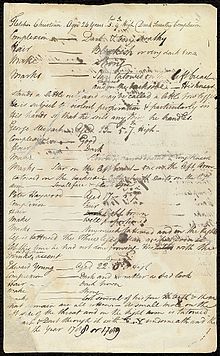
Water damaged unpublished autograph manuscript page of Bligh's voyage in the launch of HMSBounty, from the ship to Tofua and from thence to Timor April 28 to June 14, 1789, after the Mutiny. It contains notes used later every bit the footing for his report and all his subsequent narratives.
Report writer [edit]
Report writers are people who gather data, organise and document information technology then that information technology can be presented to some person or authority in a position to use it every bit the basis of a decision. Well-written reports influence policies as well equally decisions. For example, Florence Nightingale (1820–1910) wrote reports that were intended to effect administrative reform in matters apropos health in the ground forces. She documented her experience in the Crimean War and showed her decision to run into improvements: "...after six months of incredible industry she had put together and written with her own paw her Notes affecting the Health, Efficiency and Hospital Administration of the British Army. This extraordinary composition, filling more than eight hundred closely printed pages, laying down vast principles of far-reaching reform, discussing the minutest item of a multitude of controversial subjects, containing an enormous mass of information of the almost varied kinds – military, statistical, sanitary, architectural" became for a long fourth dimension, the "leading authority on the medical assistants of armies".[30] [31]
The logs and reports of Master mariner William Bligh contributed to his being honourably acquitted at the court-martial inquiring into the loss of HMSCompensation.
Scribe [edit]

Scribe in India taking instructions from a client
A scribe writes ideas and information on behalf of another, sometimes copying from another document, sometimes from oral instruction on behalf of an illiterate person, sometimes transcribing from another medium such as a record recording, autograph, or personal notes.
Being able to write was a rare achievement for over 500 years in Western Europe so monks who copied texts were scribes responsible for saving many texts from first times. The monasteries, where monks who knew how to read and write lived, provided an environment stable enough for writing. Irish monks, for case, came to Europe in about 600 and "institute manuscripts in places like Tours and Toulouse" which they copied.[32] The monastic writers also illustrated their books with highly skilled art piece of work using gold and rare colors.
Technical writer [edit]
A technical writer prepares instructions or manuals, such equally user guides or owner's manuals for users of equipment to follow. Technical writers besides write different procedures for business, professional person or domestic utilise. Since the purpose of technical writing is applied rather than creative, its most important quality is clarity. The technical writer, unlike the creative author, is required to adhere to the relevant mode guide.
Process and methods [edit]
Writing process [edit]
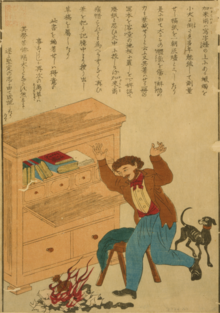
Japanese impress depicting Thomas Carlyle'south horror at his manuscript burning
There is a range of approaches that writers take to the task of writing. Each writer needs to detect their own procedure and nearly describe it as more or less a struggle.[33] Sometimes writers accept had the bad fortune to lose their piece of work and accept had to beginning again. Before the invention of photocopiers and electronic text storage, a writer'southward piece of work had to be stored on paper, which meant it was very susceptible to fire in particular. (In very earlier times, writers used vellum and clay which were more robust materials.) Writers whose work was destroyed earlier completion include L. L. Zamenhof, the inventor of Esperanto, whose years of work were thrown into the burn down by his begetter considering he was agape that "his son would be thought a spy working lawmaking".[34] Essayist and historian Thomas Carlyle, lost the just re-create of a manuscript for The French Revolution: A History when it was mistakenly thrown into the burn by a maid. He wrote it again from the get-go.[35] Writers unremarkably develop a personal schedule. Angus Wilson, for example, wrote for a number of hours every morning.[36]
Writer'south block is a relatively common experience among writers, specially professional writers, when for a menses of fourth dimension the writer feels unable to write for reasons other than lack of skill or commitment.
Happy are they who don't doubt themselves and whose pens fly beyond the page
Gustave Flaubert writing to Louise Colet[37]
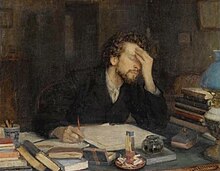
Sole [edit]
Nigh writers write alone – typically they are engaged in a solitary activity that requires them to struggle with both the concepts they are trying to limited and the best style to express information technology. This may mean choosing the all-time genre or genres every bit well every bit choosing the all-time words. Writers often develop idiosyncratic solutions to the problem of finding the right words to put on a bare page or screen. "Didn't Somerset Maugham as well write facing a blank wall? ... Goethe couldn't write a line if there was another person anywhere in the same house, or so he said at some point."[38]
Collaborative [edit]
Collaborative writing means that other authors write and contribute to a part of writing. In this arroyo, it is highly probable the writers will interact on editing the part as well. The more than usual process is that the editing is done by an independent editor subsequently the author submits a draft version.
In some cases, such as that between a librettist and composer, a writer will collaborate with another artist on a creative piece of work. One of the best known of these types of collaborations is that betwixt Gilbert and Sullivan. Librettist W. S. Gilbert wrote the words for the comic operas created past the partnership.
Committee [edit]
Occasionally, a writing job is given to a commission of writers. The most best-known example is the task of translating the Bible into English language, sponsored by King James VI of England in 1604 and accomplished by half-dozen committees, some in Cambridge and some in Oxford, who were allocated unlike sections of the text. The resulting Authorized King James Version, published in 1611, has been described as an "everlasting miracle" because its writers (that is, its Translators) sought to "agree themselves consciously poised between the claims of accessibility and beauty, plainness and richness, simplicity and majesty, the people and the king", with the event that the language communicates itself "in a way which is quite unaffected, neither literary nor bookish, non historical, nor reconstructionist, just transmitting a nearly incredible immediacy from one end of human civilization to some other."[39]
Multimedia [edit]

Some writers back up the verbal role of their work with images or graphics that are an integral office of the way their ideas are communicated. William Blake is one of rare poets who created his own paintings and drawings as integral parts of works such equally his Songs of Innocence and of Experience. Cartoonists are writers whose work depends heavily on hand drawn imagery. Other writers, especially writers for children, incorporate painting or drawing in more or less sophisticated ways. Shaun Tan, for example, is a writer who uses imagery extensively, sometimes combining fact, fiction and illustration, sometimes for a didactic purpose, sometimes on committee.[40] Children'south writers Beatrix Potter, May Gibbs, and Theodor Seuss Geisel are besides known for their illustrations as for their texts.
Oversupply sourced [edit]
Some writers contribute very modest sections to a function of writing that cumulates as a result. This method is particularly suited to very large works, such equally dictionaries and encyclopaedias. The best known example of the former is the Oxford English Dictionary, under the editorship of lexicographer James Murray, who was provided with the prolific and helpful contributions of W.C. Minor, at the time an inmate of a hospital for the criminally insane.[41]
The best known example of the latter – an encyclopaedia that is crowdsourced – is Wikipedia, which relies on millions of writers and editors such as Simon Pulsifer[42] worldwide.
Motivations [edit]
Writers take many different reasons for writing, among which is ordinarily some combination of self-expression[43] and recording facts, history or research results. The many doc writers, for example, take combined their ascertainment and knowledge of the human condition with their desire to write and contributed many poems, plays, translations, essays and other texts. Some writers write extensively on their motivation and on the probable motivations of other writers. For example, George Orwell'southward essay "Why I Write" (1946) takes this as its subject area. Every bit to "what constitutes success or failure to a writer", it has been described every bit "a complicated concern, where the fabric rubs up against the spiritual, and psychology plays a big function".[44]
The moral I draw is that the writer should seek his advantage in the pleasure of his piece of work and in release from the burden of this thoughts; and, indifferent to zippo else, care zilch for praise or censure, failure or success.
Due west. Somerset Maugham in The Moon and Sixpence (1919)[45]
Command [edit]
Some writers are the authors of specific armed forces orders whose clarity will determine the issue of a boxing. Among the almost controversial and unsuccessful was Lord Raglan's social club at the Charge of the Calorie-free Brigade, which existence vague and misinterpreted, led to defeat with many casualties.
Develop skill/explore ideas [edit]
Some writers employ the writing task to develop their own skill (in writing itself or in another area of noesis) or explore an idea while they are producing a piece of writing. Philologist J. R. R. Tolkien, for instance, created a new linguistic communication for his fantasy books.
For me the private act of poetry writing is songwriting, confessional, diary-keeping, speculation, trouble-solving, storytelling, therapy, anger management, craftsmanship, relaxation, concentration and spiritual adventure all in ane inexpensive bundle.
Stephen Fry, author, poet, playwright, screenwriter, announcer[46]
Entertain [edit]
Some genres are a particularly appropriate choice for writers whose chief purpose is to entertain. Amongst them are limericks, many comics and thrillers. Writers of children's literature seek to entertain children but are also usually mindful of the educative part of their work as well.
I call up that I shall never run into
a billboard lovely as a tree;
Indeed, unless the billboards fall
I'll never run into a tree at all.
Ogden Nash, humorous poet, reworking a verse form by Joyce Kilmer for comic effect.[47]
Influence [edit]

Anger has motivated many writers, including Martin Luther, angry at religious abuse, who wrote the Xc-5 Theses in 1517, to reform the church, and Émile Zola (1840–1902) who wrote the public letter, J'Accuse in 1898 to bring public attention to regime injustice, every bit a consequence of which he had to flee to England from his native French republic. Such writers have affected ideas, stance or policy significantly.
Payment [edit]
Even though he is in beloved with the aforementioned woman, Cyrano helps his inarticulate friend, Rageneau, to woo her by writing on his behalf ...
CYRANO: What 60 minutes is it now, Ragueneau?
RAGUENEAU (stopping short in the human action of thrusting to await at the clock): V minutes later on six!...'I touch!' (He straightens himself): ...Oh! to write a ballade!
...
RAGUENEAU: Ten minutes after six.
CYRANO: (nervously seating himself at Ragueneau's table, and cartoon some paper toward him): A pen!. . .
RAGUENEAU (giving him the one from behind his ear): Here – a swan's quill.
...
CYRANO (taking up the pen, and motioning Ragueneau away): Hush! (To himself): I volition write, fold it, requite it her, and wing! (Throws down the pen): Coward! ...But strike me dead if I dare to speak to her, ...ay, even i unmarried discussion! (To Ragueneau): What time is it?
RAGUENEAU: A quarter after six! ...
CYRANO (striking his breast): Ay-a unmarried word of all those here! hither! But writing, 'tis easier done... (He takes upwardly the pen): Go to, I will write it, that love-alphabetic character! Oh! I have writ it and rewrit it in my own mind so oft that it lies in that location prepare for pen and ink; and if I lay but my soul by my letter-sheet, 'tis naught to practice only to copy from information technology. (He writes. ...)
Edmond Rostand, Cyrano de Bergerac
Act II, Scene two, (3)[48]
Writers may write a particular piece for payment (fifty-fifty if at other times, they write for some other reason), such equally when they are commissioned to create a new work, transcribe an original one, translate another writer's work, or write for someone who is illiterate or inarticulate. In some cases, writing has been the simply way an individual could earn an income. Frances Trollope is an instance of women who wrote to salvage herself and her family from penury, at a time when there were very few socially adequate employment opportunities for them. Her book about her experiences in the Usa, chosen Domestic Manners of the Americans became a dandy success, "even though she was over fifty and had never written before in her life" after which "she continued to write hard, conveying this on nearly entirely earlier breakfast".[49] Co-ordinate to her author son Anthony Trollope "her books saved the family unit from ruin".[49]
I write for 2 reasons; partly to make coin and partly to win the respect of people whom I respect.
E. M. Forster, novelist, essayist, librettist[50]
Teach [edit]
Aristotle, who was tutor to Alexander the Peachy, wrote to back up his didactics. He wrote two treatises for the young prince: "On Monarchy", and "On Colonies"[51] and his dialogues also appear to accept been written either "as lecture notes or word papers for employ in his philosophy schoolhouse at the Athens Lyceum betwixt 334 and 323 BC."[51] They encompass both his 'scientific' writings (metaphysics, physics, biology, meteorology, and astronomy, besides equally logic and statement) the 'non-scientific' works (poetry, oratory, ethics, and politics), and "major elements in traditional Greek and Roman education".[51]
Writers of textbooks also employ writing to teach and there are numerous instructional guides to writing itself. For example, many people will find information technology necessary to make a spoken language "in the service of your visitor, church, borough order, party, or other organization" and so, instructional writers take produced texts and guides for speechmaking.[52]
Tell a story [edit]
Many writers use their skill to tell the story of their people, community or cultural tradition, especially 1 with a personal significance. Examples include Shmuel Yosef Agnon; Miguel Ángel Asturias; Doris Lessing; Toni Morrison; Isaac Bashevis Vocalizer; and Patrick White. Writers such as Mario Vargas Llosa, Herta Müller, and Erich Maria Remarque write about the outcome of disharmonize, dispossession and war.
Seek a lover [edit]
Writers use prose, verse, and letters as function of courtship rituals. Edmond Rostand'south play Cyrano de Bergerac, written in poesy, is about both the power of love and the power of the self-doubting writer/hero's writing talent.
[edit]

Pen names [edit]
Writers sometimes employ a pseudonym, otherwise known as a pen name or "nom de plume". The reasons they practice this include to separate their writing from other piece of work (or other types of writing) for which they are known; to heighten the possibility of publication by reducing prejudice (such as confronting women writers or writers of a item race); to reduce personal risk (such as political risks from individuals, groups or states that disagree with them); or to make their name better adjust another language.
Examples of well-known writers who used a pen name include: George Eliot (1819–1880), whose existent name was Mary Anne (or Marian) Evans; George Orwell (1903–1950), whose real name was Eric Blair; George Sand (1804–1876), whose real name was Lucile Aurore Dupin; Dr. Seuss (1904–1991), whose real name was Theodor Seuss Geisel; Stendhal (1783–1842), whose real name was Marie-Henri Beyle and Mark Twain (1835–1910), whose real proper noun was Samuel Langhorne Clemens.
Apart from the large numbers of works attributable merely to "Bearding", in that location are a large number of writers who were once known and are now unknown. Efforts are made to notice and re-publish these writers' works. One example is the publication of books like Nippon Equally Seen and Described by Famous Writers (a 2010 reproduction of a pre-1923 publication) by "Anonymous".[53] Another example is the founding of a Library and Study Center for the Study of Early English Women's Writing in Chawton, England.[54]
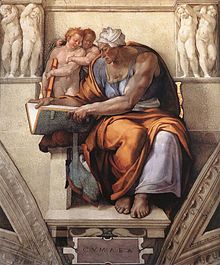
Fictional writers [edit]
Some fictional writers are very well known considering of the forcefulness of their characterization by the existent author or the significance of their role equally author in the plot of a work. Examples of this type of fictional writer include Edward Casaubon, a fictional scholar in George Eliot'due south Middlemarch, and Edwin Reardon, a fictional author in George Gissing's New Grub Street. Casaubon's efforts to complete an authoritative study affect the decisions taken by the protagonists in Eliot's novel and inspire significant parts of the plot. In Gissing'south work, Reardon's efforts to produce high quality writing put him in conflict with another character, who takes a more than commercial approach. Robinson Crusoe is a fictional writer who was originally credited by the real writer (Daniel Defoe) as existence the author of the confessional letters in the work of the same proper noun. Bridget Jones is a comparable fictional diarist created past writer Helen Fielding. Both works became well-known and pop; their protagonists and story were developed further through many adaptations, including film versions. Cyrano de Bergerac was a existent writer who created a fictional grapheme with his own name. The Sibylline Books, a collection of prophecies were supposed to have been purchased from the Cumaean Sibyl by the last king of Rome. Since they were consulted during periods of crisis, it could exist said that they are a case of real works created by a fictional writer.
Writers of sacred texts [edit]

Religious texts or scriptures are the texts which different religious traditions consider to be sacred, or of central importance to their religious tradition. Some religions and spiritual movements believe that their sacred texts are divinely or supernaturally revealed or inspired, while others have individual authors.
Controversial writing [edit]

Skilled writers influence ideas and gild, so there are many instances where a author'due south piece of work or opinion has been unwelcome and controversial. In some cases, they have been persecuted or punished. Aware that their writing will cause controversy or put themselves and others into danger, some writers cocky-censor; or withhold their work from publication; or hide their manuscripts; or utilise some other technique to preserve and protect their piece of work. Two of the almost famous examples are Leonardo da Vinci and Charles Darwin. Leonardo "had the addiction of conversing with himself in his writings and of putting his thoughts into the clearest and most simple form". He used "left-handed or mirror writing" (a technique described as "so characteristic of him") to protect his scientific inquiry from other readers.[55] The fear of persecution, social disgrace, and being proved incorrect are regarded as contributing factors to Darwin's delaying the publication of his radical and influential work On the Origin of Species.
One of the results of controversies caused past a writer'south piece of work is scandal, which is a negative public reaction that causes harm to reputation and depends on public outrage. Information technology has been said that it is possible to scandalise the public because the public "wants to be shocked in order to confirm its own sense of virtue".[56] The scandal may be caused by what the author wrote or by the style in which information technology was written. In either example, the content or the style is likely to accept cleaved with tradition or expectation. Making such a departure may in fact, be part of the writer'south intention or at least, part of the result of introducing innovations into the genre in which they are working. For case, novelist D H Lawrence challenged ideas of what was acceptable besides every bit what was expected in form. These may be regarded every bit literary scandals, merely as, in a different mode, are the scandals involving writers who mislead the public well-nigh their identity, such equally Norma Khouri or Helen Darville who, in deceiving the public, are considered to have committed fraud.
Writers may also cause the more usual type of scandal – whereby the public is outraged past the opinions, behaviour or life of the individual (an experience not limited to writers). Poet Paul Verlaine outraged guild with his behaviour and treatment of his wife and kid equally well every bit his lover. Amidst the many writers whose writing or life was affected by scandals are Oscar Wilde, Lord Byron, Jean-Paul Sartre, Albert Camus, and H. One thousand. Wells. One of the most famously scandalous writers was the Marquis de Sade who offended the public both by his writings and by his behaviour.
Punishment [edit]
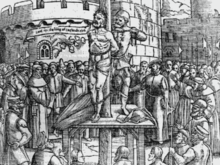
The consequence of scandal for a writer may exist censorship or discrediting of the piece of work, or social ostracism of its creator. In some instances, punishment, persecution, or prison follow. The list of journalists killed in Europe, listing of journalists killed in the U.s. and the list of journalists killed in Russia are examples. Others include:
- The Balibo V, a grouping of Australian television journalists who were killed while attempting to report on Indonesian incursions into Portuguese Timor in 1975.
- Dietrich Bonhoeffer (1906–1945), an influential theologian who wrote The Cost of Discipleship and was hanged for his resistance to Nazism.
- Galileo Galilei (1564–1642), who was sentenced to imprisonment for heresy as a consequence of writing in support of the then controversial theory of heliocentrism, although the sentence was almost immediately commuted to business firm arrest.
- Antonio Gramsci (1891–1937), who wrote political theory and criticism and was imprisoned for this by the Italian Fascist regime.
- Günter Grass (1927–2015), whose poem "What Must Be Said" led to his beingness declared persona non grata in Israel.
- Peter Greste (born 1965), a journalist who was imprisoned in Egypt for news reporting which was "dissentious to national security."[57]
- Primo Levi (1919–1987) who, amidst many Jews imprisoned during Globe State of war 2, wrote an business relationship of his incarceration called If This Is a Man.
- Sima Qian (145 or 135 BC – 86 BC) who "successfully dedicated a vilified master from defamatory charges" and was given "the selection betwixt castration or execution." He "became a eunuch and had to bury his own book ... in order to protect it from the authorities."[58]
- Salman Rushdie (born 1947), whose novel The Satanic Verses was banned and burned internationally after causing such a worldwide storm that a fatwā was issued confronting him. Though Rushdie survived, numerous others were killed in incidents connected to the novel.
- Roberto Saviano (born 1979), whose best-selling book Gomorrah provoked the Neapolitan Camorra, bellyaching Silvio Berlusconi and led to him receiving permanent constabulary protection.
- Simon Sheppard (born 1957) who was imprisoned in the UK for inciting racial hatred.
- Aleksandr Solzhenitsyn (1918–2008), who used his experience of imprisonment as the subject area of his writing in One Day in the Life of Ivan Denisovich and Cancer Ward—the latter, while legally published in the Soviet Matrimony, had to proceeds the blessing of the USSR Wedlock of Writers.
- William Tyndale (c. 1494 – 1536), who was executed because he translated the Bible into English language.
Protection and representation [edit]
The organisation Reporters Without Borders (as well known by its French name: Reporters Sans Frontières) was fix up to aid protect writers and advocate on their behalf.
The professional and industrial interests of writers are represented by various national or regional guilds or unions. Examples include writers guilds in Australia and Great Britain and unions in Arabia, Armenia, Republic of azerbaijan, Canada, Estonia, Hungary, Ireland, Moldova, Philippines, Poland, Québéc, Romania, Russia, Sudan, and Ukraine. In the United States, there is both a writers guild and a National Writers Union.
Awards [edit]

There are many awards for writers whose writing has been adjudged excellent. Amidst them are the many literary awards given by individual countries, such as the Prix Goncourt and the Pulitzer Prize, every bit well equally international awards such every bit the Nobel Prize in Literature. Russian author Boris Pasternak (1890–1960), under pressure level from his authorities, reluctantly declined the Nobel Prize that he won in 1958.
Meet also [edit]
 Writing portal
- Bookish publishing
- Hack writer
- Lists of writers
- List of women writers
- List of not-binary writers
- List of writers' conferences
- Genre fiction
- Professional writing
- Website content author
- Writer's voice
- Betty Abah
References [edit]
- ^ Magill, Frank Due north. (1974). Concordance of Earth Authors. Vol. I, II, III (revised ed.). Englewood Cliffs, New Jersey: Salem Press. pp. one–1973. [A compilation of the bibliographies and short biographies of notable authors up to 1974.]
- ^ Nobel prize winner Rabindranath Tagore is an example.
- ^ Nicolson, Adam (2011). When God Spoke English: The Making of the King James Bible. London: Harper Press. ISBN978-0-00-743100-7.
- ^ Run across, for example, Will Blythe, ed. (c. 1998). Why I write: thoughts on the practice of fiction . Boston: Little, Brown. ISBN0316102296.
- ^ Jonathan Franzen, for example, criticised John Updike for existence "exquisitely preoccupied with his own literary digestive processes ..." and his "lack of involvement in the bigger postwar, postmodern, socio-technological picture" Franzen, Jonathan (half dozen September 2013). "Franzen on Kraus: Footnote 89". The Paris Review (206). Retrieved 11 September 2013.
- ^ Graves, Robert (1957). Poems Selected past Himself. Penguin Books. p. 204.
- ^ 1936, 1954, 1955, 1966, 1968, 1978, 2013, 2014. IMDb listing.
- ^ Le Marchand, Jean (Summertime 1953). "Interviews: François Mauriac, The Fine art of Fiction No. 2". The Paris Review (two). Retrieved 3 May 2013.
- ^ The Epistle Dedicatory of A Tale of a Tub. For text at Wikisource, see A Tale of a Tub
- ^ Extract of Rodolpho'southward aria in Act I of La bohème
- ^ Lipton, James (Jump 1997). "Interview: Stephen Sondheim, The Art of the Musical". The Paris Review. Spring 1997 (142). Retrieved 3 May 2013.
- ^ a b Bartlett, Mike (18 November 2015). "Mike Bartlett on writing King Charles III". Sydney Theatre Company Magazine. Sydney Theatre Company. Retrieved 6 April 2016.
- ^ Stopppard, Tom (1967). Rosencrantz and Guildentern Are Dead. Faber and Faber. p. 75. ISBN0-571-08182-7.
- ^ The Tragedy of Hamlet, Prince of Denmark/Human activity 2, (Act Two, Sc.2, line 609)
- ^ See Season 6, Episode 22: "Muse", (Star Trek: Voyager)
- ^ For example, see Habib, M.A.R. (2005). A History of Literary Criticism and Theory . MA, USA; Oxford, UK; Victoria, Australia: Blackwell Publishing. ISBN978-0-631-23200-1.
- ^ Baudelaire, Charles (1965). "The Salon of 1845". In Mayne, Jonathan (ed.). Baudelaire – Fine art in Paris 1845–1862: Reviews of Salons and other exhibitions. Translated by Mayne, Jonathan. London: Phaidon Press. p. 1.
- ^ Warner, Beverley Ellison (2012). Famous Introductions to Shakespeare's Plays past the Notable Editors of the Eighteenth Century (1906). HardPress. ISBN978-1290807081.
- ^ "Historian". Wordnetweb.princeton.edu. Retrieved 28 June 2008.
- ^ Anthony Grafton and Robert B. Townsend, "The Parlous Paths of the Profession" Perspectives on History (Sept. 2008) online
- ^ Weinert, Friedel (2009). Copernicus, Darwin and Freud: Revolutions in the History and Philosophy of Scientific discipline. Malden, Massachusetts, USA; Oxford UK: John Wiley & Sons. ISBN978-1-4051-8184-6.
- ^ Gopnik, Adam (2007). "Introduction" to the English translation of "Le K Meaulnes". London: Penguin Books. p. 7–8. ISBN9780141441894.
- ^ Dessaix, Robert (1998). "Dandenongs Gothic: On Translation" in (then along). Sydney: Pan MacMillan Australia Ltd. p. 307. ISBN0-7329-0943-0.
- ^ a b Rettberg, Jill Walker (2008). Blogging. Cambridge United kingdom; Malden, Massachusetts USA: Polity Printing. p. 42. ISBN978-0-7456-4133-1.
- ^ Bakewell, Sarah (12 November 2010). "What Bloggers Owe Montaigne". The Paris Review . Retrieved three May 2013.
- ^ Barker and de Brito, controversially lamenting the preference for looks over experience in televised journalism. Geoffrey Barker (2 May 2013). "Switch off the Tv set babes for some real news". The Age . Retrieved three May 2013. Sam de Brito (two May 2013). "Reality's bite worse than Barker". The Sydney Morning Herald . Retrieved 3 May 2013.
- ^ For text see Letters of Abélard and Héloïse
- ^ Steven R. Cartwright, ed. (2013). A Companion to St. Paul in the Middle Ages. Leiden The Netherlands: Koninklijke, Brill, NV. p. 1. ISBN978-90-04-23672-1.
- ^ William Southward. Babcock, ed. (1990). Paul and the Legacies of Paul. Dallas: Southern Methodist University Press.
- ^ Strachey, Lytton (1918). "Florence Nightingale – 3". Eminent Victorians (1981 ed.). Penguin Modern Classics. pp. 142–3. ISBN0-fourteen-000649-4.
- ^ Nightingale, Florence. Notes on matters affecting the wellness, efficiency, and hospital administration of the British ground forces : founded chiefly on the experience of the late war. Adelaide Nutting historical nursing collection, AN 0054. London : Harrison and Sons, 1858. OCLC 7660327.
- ^ Clark, Kenneth (1969). Civilization. London: Penguin Books. pp. 28–29. ISBN0-fourteen-016589-4.
- ^ Older, Daniel José. "Writing Begins With Forgiveness: Why One of the Almost Common Pieces of Writing Advice Is Wrong". Retrieved 11 September 2015.
- ^ Bryson, Neb (1990). Female parent Tongue – The English Language. Penguin Books. p. 185. ISBN978-0-14-014305-8.
- ^ Eliot, Charles William, Ed. "Introductory Annotation" in The Harvard Classics, Vol. XXV, Part iii. New York: P.F. Collier & Son, 1909–14.
- ^ Wilson, Angus (1957). "Interview with Angus Wilson". The Paris Review (Autumn-Winter No.17). Retrieved five December 2014.
- ^ Plate caption to an image of a much-corrected folio of Madame Bovary in the Bibliothèque Municipale de Rouen. In Dark-brown, Frederick (2006). Flaubert: a biography. New York: Petty, Dark-brown and Co. ISBN9780316118781.
- ^ Hughes, Ted (1995). "Ted Hughes: The Art of Poetry No. 71". The Paris Review. Spring (134). Retrieved 12 October 2013.
- ^ Nicolson, Adam (2011). When God Spoke English language: The Making of the King James Bible. London: Harper Press. ISBN978-0-00-743100-seven. (p.240, 243)
- ^ Tan, Shaun (2012). The Oopsatoreum. Sydney: Powerhouse Publishing. ISBN9781863171441.
- ^ Winchester, Simon (1998). The Surgeon of Crowthorne: a tale of murder, madness and the beloved of words. London: Viking. ISBN0670878626.
- ^ Grossman, Lev (16 December 2006). "Simon Pulsifer: The Duke of Data". Time. Archived from the original on 10 February 2007. Retrieved 21 February 2013.
- ^ Peter Matthiessen, George Plimpton (1954). "William Styron, The Fine art of Fiction No. 5". The Paris Review (Jump). Retrieved 27 December 2014.
- ^ Sullivan, Jane (27 December 2014). "JK Rowling on turning failure into success". The Sydney Morning Herald . Retrieved 27 Dec 2014.
- ^ Maugham, Somerset (1999). "2". The Moon and Sixpence. Vintage. p. 8. ISBN9780099284765.
- ^ Fry, Stephen (2007). The Ode Less Travelled – Unlocking the Poet Within. Arrow Books. pp. xii. ISBN978-0-09-950934-9.
- ^ Nash, Ogden, "Song of the Open Route", The Confront Is Familiar (Garden City Publishing, 1941), p. 21
- ^ "Rostand, Cyrano de Bergerac: Act II, Scene 2, (iii)".
- ^ a b Moore, Katherine (1974). Victorian Wives. London, New York: Allison & Busby. pp. 65–71. ISBN0-85031-634-0.
- ^ Quoted in the introduction to the writer in the 1962 edition of E.M. Forster (1927). Aspects of the Novel. Penguin.
- ^ a b c R.G. Tanner (2000). "Aristotle's Works: The Possible Origins of the Alexandria Collection". In Roy MacLeod (ed.). The Library of Alexandria. Cairo, Egypt: The American Academy in Cairo Press. pp. 79–91. ISBN977-424-710-8.
- ^ Dowis, Richard (2000). The Lost Fine art of the Great Voice communication: How to Write I : How to Deliver It. New York: AMA publications. p. 2. ISBN0-8144-7054-8.
- ^ Bearding (2010). Japan As Seen and Described past Famous Writers (published pre-1923). BiblioLife. ISBN9781142479084.
- ^ "Chawton House Library | Home to early English women'due south writing".
- ^ "Leonardo's Manuscripts" in Leonardo de Vinci (Authoritative work, published in Italia by Istituto Geografico De Agostini, in conjunction with exhibition of Leonardo'due south work in Milan in 1938 (re-edited English translation) ed.). New York: Reynal and Visitor, in association with William Morris and Visitor. p. 157.
- ^ Wilson, Colin; Damon Wilson (2011). Scandal!: An Explosive Exposé of the Affairs, Abuse and Power Struggles of the Rich and Famous. Random Business firm.
- ^ "Egypt crisis: Al-Jazeera journalists arrested in Cairo". BBC News. 30 December 2013.
- ^ Battles, Matthew (2003). Library – An Unquiet History. London: William Heinemann. ISBN0-434-00887-7. p40
External links [edit]
-
 Media related to Writers at Wikimedia Commons
-
 Texts on Wikisource:
- Messages of Abélard and Héloïse
- Luther'south Xc-Five Theses
- Hamlet
- Gulliver'due south Travels
- A Pocket-sized Proposal
- The Battle of the Books
- Songs of Innocence
- Songs of Experience
- The History of the Decline and Fall of the Roman Empire
- Poems
- J'accuse...!
- Author:E. M. Forster
Source: https://en.wikipedia.org/wiki/Writer
0 Response to "Woman Body Drawing on Newspaper Background Newspaper Art Ideas"
Post a Comment