German Art From the Great Depression German Art From the 1930s
Nazi art policy
How practise you destroy an artwork? You tin can hide it, scratch information technology, tear it, put a slogan over information technology, burn it, or, every bit the Nazis did in 1937, simply show information technology to millions of people.
If y'all visited Munich in the summer of that year, you could see two spectacular exhibitions that were held simply a few hundred meters apart. Ane was the Great Exhibition of German Art, showcasing contempo leading examples of 'Aryan' fine art. The other was the Entartete Kunst (Degenerate Art)Exhibition, which offered a tour through the fine art that the National Socialist Party had rejected on ideological grounds. It was made up of fine art that was non considered 'Aryan' and offered a concluding glimpse before these works of art disappeared.

Great Exhibition of German Art catalogue cover, 1937 (left) and Entartete Kunst (Degenerate Art) exhibition, catalogue cover, 1937 (right)
The Entartete Kunst (Degenerate Fine art)Exhibition cleverly manipulated visitors to loathe and ridicule the art on exhibit, in function past erasing their original meaning. Until shortly before the exhibition, these paintings and sculptures had been displayed at the nation's greatest museums, just now they were the principal performers in a freak show. The shock-value was enhanced by merely assuasive over-18s into the exhibition. The lines for the Degenerate Art Exhibition went around the cake. Within, many pictures had been taken out of their frames, and were attached to walls that were emblazoned with outraged slogans. Rather than whispering respectfully, people pointed and snickered. The paintings and sculptures had lost their condition as artworks, and were now reduced to unsafe and outrageous rubbish.

Opening of the Entartete Kunst exhibition at the Schulausstellungsgebaude, Hamburg, 1938
Visual symbolism was important to the Nazis, and Hitler himself had been a painter, and so it is not surprising that they dedicated significant resources promoting their ideals through art. So how was the decision made? How were 'degenerate' and 'Aryan' artworks selected? If you lot look at the works of art that were glorified and compare them to those that were attacked by the Nazis, the differences usually seem articulate enough; experimental, personal, non-representational art was rejected, whilst conventionally 'beautiful,' stereotypically heroic fine art was revered. This seems similar an obvious line to be taken by a totalitarian government: everyone will detect these artworks beautiful, and everyone will feel and think the aforementioned affair about them, without the take chances of unwanted, random, personal, or unclear interpretations.

Adolf Hitler and Adolf Ziegler audit the installation by Willrich and Hansen of the Degenerate Art exhibition in Munich, 1937
A simple decision
And the Nazis presented information technology equally a simple determination, any truthful German language would immediately be able to tell the difference. But in reality, a 4-yr battle was fought all the way to the top echelons of the Nazi hierarchy over what 'Aryan' fine art was supposed to be, exactly. The opinions on this could not have been more contradictory, and top Nazi officials such as Heinrich Himmler, Joseph Goebbels and Alfred Rosenberg championed the art they each preferred.
Surprisingly, before 1937, Goebbels–and many other Nazis–collected mod art. Goebbels had works of mod art in his study, his living room and was a fan of many artists that eventually ended up in the Degenerate Fine art Exhibition. Heinrich Himmler was interested in mystical, Germanic art that harked dorsum to a tribal by. Another influential Nazi, Alfred Rosenberg, liked the pastoral, romantic style that depicted humble farmers, rural landscapes and blond maidens.
Hitler would have none of it. He loathed Expressionism and modern art whilst pastoral idylls were not serious plenty. Goebbels reversed himself and became one of the driving forces backside the Degenerate Art Exhibition, prosecuting the same artworks he had once enjoyed. Rosenberg also let go, albeit reluctantly, whilst Himmler changed tack and stole artworks by the wagonload behind Hitler's dorsum throughout the war.
How was "Aryan" art defined?
In a sense, the concept of "Aryan" art was defined by what it was non: anything that was ideologically problematic (that did non fit with the extremist beliefs of the regime) was removed until there lilliputian left but an academic style that celebrated youth, optimism, power and eternal triumph. Notwithstanding, information technology remained hard for even the virtually influential Nazis to understand the selection criteria for fine art sanctioned by the land.

Hitler and Ziegler judging the Corking German Art Exhibition, 1937
Take for example Adolf Ziegler, who had been in accuse of selecting the artwork to be exhibited in the Neat Exhibition of German Fine art. Only earlier the show opened, Hitler visited in lodge to inspect the artwork chosen to stand for the eternal time to come of Nazi Germany. He was not pleased with the selection his virtually loyal followers had made. On the 5th of June, 1937, Goebbels wrote in his diary that the Führer was "wild with rage" and subsequently issued a statement declaring "I volition not tolerate unfinished paintings," meaning that the exhibition had to be reconceived at the last minute.
Even opportunistic "hard-liners" like Adolf Ziegler, an artist favored by Hitler, were not quite able to fulfill their patron'south vision. Still, it would not exist right to conclude that the criteria for art that represented the 'Aryan' state appears to have been based principally on the centre of Adolf Hitler rather than a fix of delineated characteristics. Fifty-fifty Hitler's taste was not the ultimate indicator of 'Aryan' art: whilst planning what great artworks he would take from the conquered museums of Europe for his never-realized Führer-Museum, he was convinced by his newly appointed museum director that his taste was not up to standard for the world-class museum he envisaged. Rather than firing the homo, Hitler deferred to this Dr. Hans Posse, despite the fact that he had recently been fired from his post every bit museum director in Dresden for endorsing "degenerate fine art."
What was actually on display in the two exhibitions?

Ernst Barlach, The Reunion (Das Wiedersehen), 1926, mahogany, ninety x 38 ten 25 cm (Ernst Barlach Haus, Hamburg), (photo: Rufus46, CC-BY-SA 3.0)
The Degenerate Art Exhibition generally exhibited Expressionism, New Objectivism and some abstract art. Strangely, very few works came from Jewish artists, and a lot of artworks had until recently been favorites of many Nazis. Renowned works by artists such every bit Ernst Ludwig Kirchner, Karl Schmidt-Rotluff and Ernst Barlach at present hung on walls marked with graffiti. The works ranged from serenity and traditional looking, such as Ernst Barlach's The Reunion (Das Wiedersehen), 1926 which showed ii poised, realistically carved wooden figures holding each other, to more grotesquely painted works, such every bit Otto Dix' War Cripples (Kriegskrüppel), 1920. This work shows a procession of cartoonesque all the same morbid state of war veterans, painfully moving frontwards with the aid of pushchairs, prosthetic legs and crutches, smoking cheerfully, though one soldier'south face is half eaten abroad, revealing a rictus grin of clenched teeth.

Otto Dix, War Cripples (45% Fit for Service), 1920, oil on canvas, lost work

Arno Breker, Decathlon Athlete (Zehnkämpfer), 1936, bronze
In contrast, the Peachy Exhibition of German Art showed fine art with the hallmarks of classical tradition, large sculptures of tall and muscular bodies and paintings of heroic soldiers by artists such as Josef Thorak and Arno Breker. Prominent position was given to Breker'due south Decathlete ('Zehnkämpfer') and Victory ('Siegerin'), both made in 1936, showing two bronze figures over 3 metres high, their impersonal facial expressions and perfectly proportioned bodies nearly archetypical examples of the classical style.
However, in after editions of the Great Exhibition of German Fine art, works that did not fit the ethics of dazzler, youth and optimism crept dorsum in. Realistically painted works depicting soldiers despairing in the trenches past Albert Heinrich and sad, emaciated figures like the bust Der Walzmeister by Fritz Koelle began to share the space with oversized muscular statuary men and paintings of serene nude women.
The random nature of Nazi art policy connected after these exhibitions closed. Breker and Thorak, superstars of the Nazi regime, really had some works branded equally degenerate (though this was quickly covered up), whereas the artist Emil Nolde, who joined the Nazi party and was an early and enthusiastic supporter, had been issued a so-called Malverbot forbidding him to paint even in the privacy of his ain home. He received regular visits from the Gestapo, the secret police, who came to touch on his brushes to ensure that they had not been used. Nolde became a water-colour painter. The brushes stale a lot faster than with oil pigment.

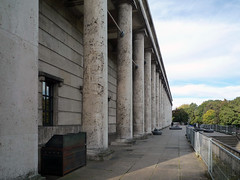
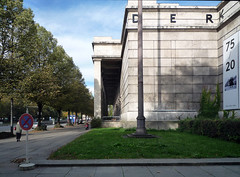
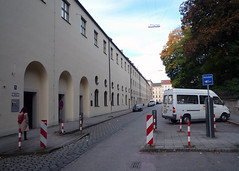
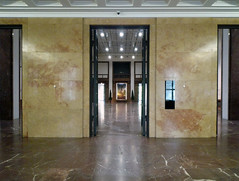
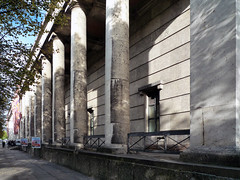
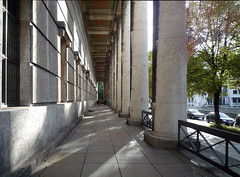
View of sculpture exhibited at the Haus of German Art, northward.d.
Boosted Resources:
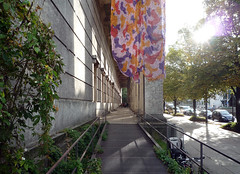
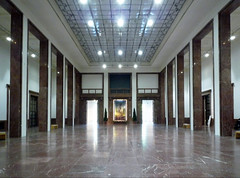
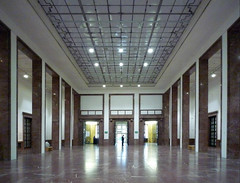
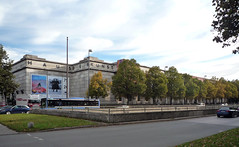
Website for this building today: The House of Fine art
Dr. Nausikaa El-Mecky, "Monuments men are all the rage, but we're still agape of Nazi art," The Conversation
Culture in the Third Reich: Disseminating the Nazi Worldview
A Teacher'south Guide to the Holocaust
Extract of Hitler's Speech communication at the inauguration of the Business firm of German Fine art
Smarthistory images for teaching and learning:
More Smarthistory images…
Source: https://smarthistory.org/art-in-nazi-germany/
0 Response to "German Art From the Great Depression German Art From the 1930s"
Post a Comment