Philadelphia Museum of Art 2600 Benjamin Franklin Pkwy Philadelphia Pa 19130
|
| |
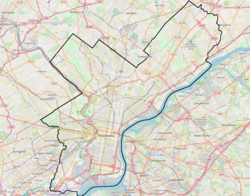
| Location inside Philadelphia Testify map of Philadelphia Philadelphia Museum of Art (Pennsylvania) Bear witness map of Pennsylvania Philadelphia Museum of Art (the United States) Prove map of the U.s.a. | |
| Established | February 1876 (1876-02) [1] |
|---|---|
| Location | 2600 Benjamin Franklin Parkway, Philadelphia, Pennsylvania[ii] |
| Coordinates | 39°57′58″North 75°x′52″Due west / 39.966°N 75.181°W / 39.966; -75.181 Coordinates: 39°57′58″North 75°x′52″W / 39.966°North 75.181°W / 39.966; -75.181 |
| Type | Fine art museum |
| Collection size | 240,000[3] |
| Visitors | 793,000 (2017)[4] |
| Director | Timothy Rub[5] |
| President | Gail Harrity |
| Chairperson | Constance H. Williams |
| Builder | Horace Trumbauer Zantzinger, Borie and Medary Howell Lewis Shay Julian Abele |
| Public transit access |   SEPTA bus: 38, 43 Philly PHLASH, Suburban Station SEPTA bus: 38, 43 Philly PHLASH, Suburban Station |
| Website | world wide web.philamuseum.org |
| Philadelphia Annals of Historic Places | |



The Philadelphia Museum of Art is an fine art museum originally chartered in 1876 for the Centennial Exposition in Philadelphia.[i] The main museum edifice was completed in 1928[6] on Fairmount, a hill located at the northwest terminate of the Benjamin Franklin Parkway at Eakins Oval.[2] The museum administers collections containing over 240,000 objects including major holdings of European, American and Asian origin.[3] The various classes of artwork include sculpture, paintings, prints, drawings, photographs, armor, and decorative arts.[three]
The Philadelphia Museum of Fine art administers several annexes including the Rodin Museum, as well located on the Benjamin Franklin Parkway, and the Ruth and Raymond K. Perelman Building, which is located beyond the street simply n of the main building.[vii] The Perelman Building, which opened in 2007,[8] houses more than 150,000 prints, drawings and photographs, forth with 30,000 costume and textile pieces, and over ane,000 modern and contemporary design objects including piece of furniture, ceramics and glasswork.[9] The museum also administers the historic colonial-era houses of Mount Pleasant and Cedar Grove, both located in Fairmount Park.[10] The main museum edifice and its annexes are owned by the City of Philadelphia and administered by a registered nonprofit corporation.[7]
Several special exhibitions are held in the museum every yr, including touring exhibitions arranged with other museums in the United states of america and away.[eleven] [12] The museum had 437,348 visitors in 2021, ranking 65th on the List of most-visited art museums worldwide.[13]
History [edit]
Philadelphia celebrated the 100th ceremony of the Annunciation of Independence with the Centennial Exposition in 1876. Memorial Hall, which contained the art gallery, was intended to outlive the Exposition and house a permanent museum. Following the example of London's South Kensington Museum, the new museum was to focus on practical art and science, and provide a school to railroad train craftsmen in drawing, painting, modeling, and designing.[i]
The Pennsylvania Museum and School of Industrial Art opened on May 10, 1877. (The school became contained of the museum in 1964 and is now office of the University of the Arts). The museum's collection began with objects from the Exposition and gifts from the public impressed with the Exposition'southward ideals of good design and craftsmanship. European and Japanese fine and decorative art objects and books for the museum's library were amongst the get-go donations. The location outside of Middle Urban center, nevertheless, was adequately distant from many of the city's inhabitants.[xiv] Admission was charged until 1881, and then was dropped until 1962.[xv]
Starting in 1882, Clara Jessup Moore donated a remarkable drove of antique article of furniture, enamels, carved ivory, jewelry, metalwork, drinking glass, ceramics, books, textiles and paintings. The Countess de Brazza's lace collection was acquired in 1894 forming the nucleus of the lace collection. In 1892 Anna H. Wilstach bequeathed a large painting drove, including many American paintings, and an endowment of one-half a one thousand thousand dollars for additional purchases. Works by James Abbott McNeill Whistler and George Inness were purchased within a few years and Henry Ossawa Tanner's The Announcement was bought in 1899.[xv]

Fairmount Parkway plan, 1917
In the early on 1900s, the museum started an education program for the full general public, as well every bit a membership program.[16] Fiske Kimball was the museum director during the rapid growth of the mid- to late-1920s, which included one million visitors in 1928—the new building's first year. The museum enlarged its print drove in 1928 with about five,000 Old Master prints and drawings from the gift of Charles M. Lea, including French, German, Italian, and Netherlandish engravings.[6] Major exhibitions of the 1930s included works by Eakins, Manet, Renoir, Cézanne, van Gogh, and Degas.[17] In the 1940s, the museum's major gifts and acquisitions included the collections of John D. McIlhenny (Oriental carpets), George Grayness Barnard (sculpture), and Alfred Stieglitz (photography).[xviii]
Early modern fine art dominated the growth of the collections in the 1950s, with acquisitions of the Louise and Walter Arensberg and the A.Eastward. Gallatin collections. The souvenir of Philadelphian Grace Kelly'south wedding dress is possibly the best known souvenir of the 1950s.[19]
All-encompassing renovation of the edifice lasted from the 1960s through 1976. Major acquisitions included the Carroll Due south. Tyson, Jr. and Samuel Due south. White III and Vera White collections, 71 objects from designer Elsa Schiaparelli, and Marcel Duchamp'due south Étant donnés. In 1976 there were celebrations and special exhibitions for the centennial of the museum and the bicentennial of the nation. During the last 3 decades major acquisitions have included After the Bath past Edgar Degas and Fifty Days at Iliam by Cy Twombly.[nineteen]
Main edifice [edit]
The City Council of Philadelphia funded a contest in 1895 to design a new museum building,[fifteen] simply it was not until 1907 that plans were outset fabricated to construct it on Fairmount, a rocky hill topped by the city's primary reservoir. The Fairmount Parkway (renamed Benjamin Franklin Parkway), a grand boulevard that cut diagonally across the grid of city streets, was designed to terminate at the foot of the hill. Merely in that location were conflicting views about whether to erect a unmarried museum building, or a number of buildings to business firm individual collections. The architectural firms of Horace Trumbauer and Zantzinger, Borie and Medary collaborated for more than than a decade to resolve these problems. The last design is mostly credited to 2 architects in Trumbauer's firm: Howell Lewis Shay for the building'southward plan and massing, and Julian Abele for the item piece of work and perspective drawings.[20] In 1902, Abele had become the first African-American student to be graduated from the University of Pennsylvania's Department of Architecture, which is soon known as Penn'south School of Design.[21] Abele adapted classical Greek temple columns for the pattern of the museum entrances, and was responsible for the colors of both the building stone and the figures added to ane of the pediments.[22]
Construction of the main building began in 1919, when Mayor Thomas B. Smith laid the cornerstone in a Masonic ceremony. Because of shortages caused by World War I and other delays, the new building was not completed until 1928.[xix] The edifice was constructed with dolomite quarried in Minnesota.[23] The wings were intentionally built first, to aid assure the continued funding for the completion of the design. One time the building's outside was completed, twenty second-floor galleries containing English and American art opened to the public on March 26, 1928, though a big corporeality of interior work was incomplete.[6]

Pediment with polychrome sculpture past Jennewein and Solon on the north wing, at the due east entrance
The building'southward eight pediments were intended to be adorned with sculpture groups. The only pediment that has been completed, Western Civilization (1933) by C. Paul Jennewein, colored by Leon Five. Solon, features polychrome sculptures of painted terra-cotta figures depicting Greek deities and mythological figures.[24] The sculpture grouping was awarded the Medal of Honor of the Architectural League of New York.[25]
The building is besides adorned past a collection of bronze griffins, which were adopted as the symbol of the museum in the 1970s.[14]
List of directors [edit]

Below is the list of directors of the Philadelphia Museum of Art:
- Timothy Rub, 2009–present
- Anne d'Harnoncourt, 1982–2008
- Jean Sutherland Boggs, 1978–1982[26]
- Evan Hopkins Turner, 1964–1977[27]
- Arnold H. Jolles, 1977–1979 (acting)[28]
- Henri Gabriel Marceau, 1955–1964[29]
- Fiske Kimball, 1925–1955
- Sr. Samuel W. Woodhouse, 1923–1925 (interim)[30]
- Langdon Warner, 1917–1923[31]
- Edwin Atlee Hairdresser, 1907–1916[32]
- William Platt Pepper, 1899–1907
- Dalton Dorr, 1892–1899[33]
- William W. Justice, 1879–1880
- William Platt Pepper, 1877–1879
List of Chairs of the Board of Trustees
Below is the list of directors of the Philadelphia Museum of Art:
- Leslie A. Miller 2016–present[34]
- Constance H. Williams 2010-2016
- Gerry Lenfest 2001-2009
- Raymond Perlman 1991-2001[34]
Collections [edit]

The museum houses more than than 240,000 objects,[3] highlighting the creative achievements of the Western world and those of Asia, in more than 200 galleries spanning 2,000 years.[35] The museum's collections of Egyptian and Roman art, as well every bit many of its Pre-Columbian works, were relocated to the Penn Museum afterward an exchange agreement was made whereby the museum houses the university'south collection of Chinese porcelain.[36]
Highlights of the Asian collections include paintings and sculpture from China, Japan, and Bharat; furniture and decorative arts, including major collections of Chinese, Japanese, and Korean ceramics; a big and distinguished group of Persian and Turkish carpets; and rare and authentic architectural assemblages such as a Chinese palace hall, a Japanese teahouse, and a 16th-century Indian temple hall.[3]
The European collections, dating from the medieval era to the present, comprehend Italian and Flemish early-Renaissance masterworks; strong representations of later European paintings, including French Impressionism and Mail service-Impressionism; sculpture, with a special concentration in the works of Auguste Rodin; decorative arts; tapestries; furniture; the second-largest drove of arms and armor in the U.s.; and period rooms and architectural settings ranging from the facade of a medieval church in Burgundy to a superbly decorated English language drawing room by Robert Adam.[3]
The museum's American collections, surveying more than than three centuries of painting, sculpture, and decorative arts, are among the finest in the U.s., with outstanding strengths in 18th- and 19th-century Philadelphia furniture and silver, Pennsylvania High german art, rural Pennsylvania furniture and ceramics, and the paintings of Thomas Eakins. The museum houses the well-nigh important Eakins collection in the world.[3]
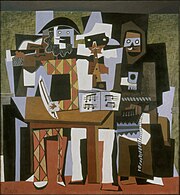
Modern artwork includes works past Pablo Picasso, Jean Metzinger, Antonio Rotta, Albert Gleizes, Marcel Duchamp, Salvador Dalí and Constantin Brâncuși, likewise equally American modernists. The expanding collection of contemporary art includes major works by Agnes Martin, Cy Twombly, Jasper Johns, and Sol LeWitt, among many others.[3]
The museum houses encyclopedic holdings of costume and textiles, as well as prints, drawings, and photographs that are displayed in rotation for reasons of preservation.[3]
The Carl Otto Kretzschmar von Kienbusch Collection [edit]
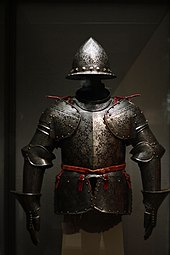
Armor, Milan, Italy, c.1600
The museum also houses the armor collection of Carl Otto Kretzschmar von Kienbusch. The Von Kienbusch collection was ancestral past the celebrated collector to the museum in 1976, the Bicentennial Anniversary of the American Revolution. The Von Kienbusch holdings are comprehensive and include European and Southwest Asian arms and armor spanning several centuries.[37]
On May xxx, 2000, the museum and the Land Art Collections in Dresden, Federal republic of germany (Staatliche Kunstsammlungen Dresden), announced an agreement for the return of 5 pieces of armor stolen from Dresden during World State of war Two.[38] In 1953, Von Kienbusch had unsuspectingly purchased the armor, which was part of his 1976 heritance. Von Kienbusch published catalogs of his drove, which eventually led Dresden authorities to bring the matter up with the museum.[39] [40]
Special exhibitions [edit]
Each year the museum organizes several special exhibitions.[11] [12] Special exhibitions have featured Salvador Dalí in 2005,[41] Paul Cézanne in 2009,[42] Auguste Renoir in 2010,[43] Vincent van Gogh in 2012,[44] Pablo Picasso in 2014,[45] John James Audubon and Andy Warhol (et al.) in 2016,[46] Winslow Homer and John Singer Sargent in 2017,[47] and the Duchamp siblings—Marcel, Gaston, Raymond and Suzanne—in 2019.[48] A Jasper Johns exhibition is planned for 2021.[49] [50]
In 2009, the museum organized Bruce Nauman: Topological Gardens, the official United States entry at the 53rd International Fine art Exhibition, more commonly known as the Venice Biennale, for which the artist Bruce Nauman was awarded the Gold King of beasts.[51]
Gallery expansion [edit]
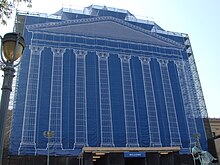
The westward entrance covered during structure in 2008
Due to high attendance and overflowing collections, the museum appear in October 2006 that Frank Gehry would pattern a building expansion. The 80,000-square-foot (7,400 ktwo) gallery will be congenital entirely hugger-mugger behind the e entrance stairs and will not alter any of the museum's existing Greek revival facade. The structure was initially projected to last a decade and cost $500 million. It will increase the museum's available display space by 60 percent and business firm mostly contemporary sculpture, Asian fine art, and special exhibitions.[52] [53]
Dubiety was cast on the plans by the 2008 expiry of Anne d'Harnoncourt, but new director Timothy Rub, who had initiated a $350 million expansion at the Cleveland Museum of Art, volition be carrying out the plans every bit scheduled. In 2010, Gehry attended the groundbreaking for the second phase of the expansion, due to be completed in 2012. In that phase, a new fine art handling facility was created on the south side of the edifice, enabling the museum to reclaim a street level archway, closed since the mid-1970s, which leads to a 640-pes (200 thousand)-long vaulted walkway that extends across the museum and is original to the 1928 building.[54] The north entrance volition be reopened to the public equally a part of the "core project", which is scheduled for completion in 2020.[55] The core project also focuses on the interior of the current edifice and will add xc,000 square anxiety (8,400 mtwo) of public space, including xi,500 square anxiety (ane,070 m2) of new gallery infinite for American art and contemporary art.[56] In addition, a new space called the forum will be created, forth with dining and retail spaces. Said Gehry: "When information technology'southward done, people coming to this museum will have an experience that's as large as Bilbao. It won't be apparent from the outside, just it will knock their socks off inside."[53] [57]
In March 2017 the museum announced a $525 million campaign.[56] The cadre projection is budgeted at $196 million and will be funded through the campaign.[56] The museum besides announced that more than than 62 percent of the campaign goal has been met, as of March 30, 2017.[56]
The about controversial role of the Gehry design remains a proposed window and amphitheater to be cut into the east entrance stairs.[58] Others have criticized the design as as well tame.[59] The Gehry expansion is projected to be completed past 2028.[60]
Drove highlights – paintings [edit]
See also Category:Paintings of the Philadelphia Museum of Fine art.
-

-

-

-

-

-

-
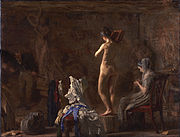
Thomas Eakins, William Rush Carving his Emblematic Effigy of Schuylkill River, 1876–1877
-

-

-
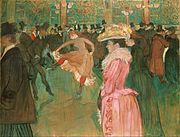
-

-

-

-

Marc Chagall, Trois heures et demie (Le poète), Half-By 3 (The Poet), 1911
-

-

In popular culture [edit]
Besides being known for its architecture and collections, the Philadelphia Museum of Fine art has in contempo decades go known due to the role information technology played in the Rocky films—Rocky (1976) and half-dozen of its seven sequels, Ii, 3, V, Rocky Balboa, Creed, and Creed Ii. Visitors to the museum are often seen mimicking Rocky Balboa's (portrayed by Sylvester Stallone) famous run up the east entrance stairs, informally nicknamed the Rocky Steps.[61] Screen Junkies named the museum'southward stairs the second nearly famous film location backside just Grand Central Station in New York.[62]
An 8.5 ft (2.6 m) tall bronze statue of the Rocky Balboa character was commissioned in 1980 and placed at the top of the stairs in 1982 for the filming of Rocky 3. After filming was complete, Stallone donated the statue to the city of Philadelphia. The Philadelphia Fine art Commission eventually decided to relocate the statue to the now-defunct Spectrum sports arena due to controversy over its prominent placement at the top of the museum's front stairs and questions virtually its artistic merit. The statue was placed briefly on top of the stairs again for the film Rocky V then returned to the Spectrum. In 2006, the statue was relocated to a new display expanse on the due north side of the base of operations of the stairs.[63] [64]
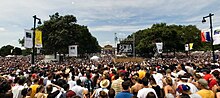
Live viii, Ben Franklin Parkway, museum in the altitude, 2005
The museum provides the backdrop for concerts and parades because of its location at the end of the Ben Franklin Parkway. The museum's e entrance surface area played host to the American venue of the international Live eight concert held on July two, 2005, with musical artists including Dave Matthews Ring, Linkin Park and Maroon 5.[65] The Philadelphia Freedom Concert, orchestrated and headlined past Elton John, was held two days later on the same outdoor phase from the Live viii concert[66] while a preceding ball was held within the museum.[67]
On September 26, 2015, the Festival of Families issue, attended by Pope Francis, was held along the Ben Franklin Parkway with musical performances past diverse acts within Eakins Oval in forepart of the museum, besides as in Logan Square.[68] [69] [70]
On April 27, 2017, the 2017 NFL Typhoon was held at the museum through April 29 of that year.
On February 8, 2018, the victory parade for the Philadelphia Eagles' win in Super Basin LII finished upon the museum steps, where players and team personnel gave speeches from a lectern to the large crowd gathered forth Ben Franklin Parkway.[71]
Run into also [edit]
- third Sculpture International
- lxx Sculptors, photo by Herbert Gehr
- Barnes Foundation
- Pennsylvania Academy of the Fine Arts
- Woodmere Art Museum
References [edit]
- ^ a b c "Centennial Origins: 1874–1876". History. Philadelphia Museum of Art. Retrieved May 21, 2012.
- ^ a b "Philadelphia Museum of Art: Homepage". Philadelphia Museum of Art. Retrieved March 3, 2016.
- ^ a b c d e f m h i "Search Collections". Philadelphia Museum of Art. Retrieved February 25, 2016.
- ^ Robert T. Rambo (n.d.). "2017 Annual Written report" (PDF). Philadelphia Museum of Art. p. 19 (of PDF file). Archived (PDF) from the original on March 28, 2018. Retrieved March 28, 2018.
Access income of $v.four one thousand thousand and attendance of 793,000 were essentially at the same levels equally 2016.
- ^ "Philadelphia Museum of Art: Nearly Us: Administration - Board of Trustees". Philadelphia Museum of Art. Retrieved March 3, 2016.
- ^ a b c "Philadelphia Museum of Art: About Usa: Our Story: 1920-1930". Philadelphia Museum of Art. Retrieved March 14, 2016.
- ^ a b "Nearly Us: Administration". Philadelphia Museum of Art. Retrieved February 25, 2016.
- ^ "About Us : Our Story : Perelman Building - Renovations and Expansion". Philadelphia Museum of Art. Retrieved March 3, 2016.
- ^ "Nigh Us : Our Story : Perelman Building - Galleries & Spaces". Philadelphia Museum of Art. Retrieved March three, 2016.
- ^ "Visiting : Plan Your Visit : Historic Houses". Philadelphia Museum of Art. Retrieved Dec 18, 2017.
- ^ a b "On View: By Exhibitions". Philadelphia Museum of Art. Retrieved February 25, 2016.
- ^ a b "On View: Current Exhibitions". Philadelphia Museum of Fine art. Retrieved Feb 25, 2016.
- ^ The Art Newspaper, March 28, 2022
- ^ a b "Philadelphia Museum of Art :: Benjamin Franklin Parkway, Philadelphia, Pennsylvania, U.s.". Glass Steel and Stone. Archived from the original on May xi, 2013. Retrieved Jan 28, 2014.
- ^ a b c "The Early on Decades: 1877–1900". philamuseum.org. Philadelphia Museum of Art. Retrieved October 22, 2018.
- ^ "About Us: Our Story: 1900-1910". philamuseum.org. Philadelphia Museum of Art. Retrieved March 27, 2018.
- ^ "About Us: Our Story: 1930-1940". philamuseum.org. Philadelphia Museum of Fine art. Retrieved March 27, 2018.
- ^ "About Us: Our Story: 1940-1950". philamuseum.org. Philadelphia Museum of Art. Retrieved March 27, 2018.
- ^ a b c "An Overview of the Museum's History". philamuseum.org. Philadelphia Museum of Fine art. Retrieved March 27, 2018.
- ^ David B. Brownlee, Making a Mod Classic: The Compages of the Philadelphia Museum of Art (Philadelphia Museum of Art, 1997), pp. 60–61, 72–73.
- ^ Tatman, Sandra 50. "Abele, Julian Francis (1881 - 1950) Architect". philadelphiabuildings.org. The Archives of Philadelphia. Retrieved March 24, 2017.
- ^ "Julian Francis Abele (1881-1950): First African American graduate of the Schoolhouse of Fine Arts". design.upenn.edu. University of Pennsylvania School of Design. Retrieved March 24, 2017.
- ^ "Galleries and Gardens: Discover blossoming works of art in Philadelphia's dark-green spaces". With Art Philadelphia. Archived from the original on April 10, 2016. Retrieved March 28, 2016.
- ^ Samuels, Tanyanika (June 2, 2011). "Bronx street rename for borough's ain sculptor Carl Paul Jennewein". The New York Daily News. p. 31. Retrieved March 28, 2016.
- ^ Lowey, Nita M. "New York: C. Paul Jennewein, Sculptor (Local Legacies: Jubilant Community Roots - Library of Congress)". Retrieved March 28, 2016.
- ^ Jean Sutherland Boggs records, from Philadelphia Museum of Fine art.
- ^ Evan H. Turner records, from Philadelphia Museum of Art.
- ^ "Arnold H. Jolles Records", Philadelphia Museum of Art Archives, Accessed online April 16, 2017.
- ^ Henri Gabriel Mareau Managing director records, from Philadelphia Museum of Art.
- ^ "Our Story: 1920 – 1930", Philadelphia Museum of Art, Accessed April sixteen, 2017.
- ^ Langdon Warner records, from Philadelphia Museum of Fine art.
- ^ Edwin Atlee Barber records, from Philadelphia Museum of Art.
- ^ Dalton Dorr records, from Philadelphia Museum of Art.
- ^ a b "Constance H. Williams Announces Leslie A. Miller as Her Successor as the Museum'south Board of Trustees Chair". Constance H. Williams Announces Leslie A. Miller as Her Successor as the Museum's Lath of Trustees Chair . Retrieved August 1, 2020.
- ^ "Philadelphia Museum of Art: Most". ARTINFO. 2008. Archived from the original on Dec 10, 2008. Retrieved July 29, 2008.
- ^ "Ofttimes Asked Questions: What does the Museum's collection include?" (annal). philamuseum.org. Philadelphia Museum of Fine art. Retrieved March 27, 2018.
- ^ "Philadelphia Museum of Art - Data : Press Room : Printing Releases : 2004". Philamuseum.org. September 27, 2004. Archived from the original on February 2, 2014. Retrieved January 28, 2014.
- ^ "PMA press release". Philamuseum.org. December xvi, 1999. Retrieved January 28, 2014.
- ^ Carl Otto Kretzschmar von Kienbusch and the Collecting of Artillery and Armor in America, Donald J. LaRocca, Philadelphia Museum of Fine art Bulletin, Vol. 81, No. 345, Kienbusch Centennial (Winter, 1985), pp. 2+four-24, doi:10.2307/3795448
- ^ Armor Drove at arthistorians.info.
- ^ "On View: By Exhibitions: 2005 - Salvador Dalí". Philadelphia Museum of Art. Retrieved March 28, 2016.
- ^ "On View: By Exhibitions: 2009 - Cézanne and Beyond". Philadelphia Museum of Fine art. Retrieved March 28, 2016.
- ^ "On View: By Exhibitions: 2010 - Late Renoir". Philadelphia Museum of Art. Retrieved March 28, 2016.
- ^ "On View: Past Exhibitions: 2012 - Van Gogh Up Shut". Philadelphia Museum of Art. Retrieved March 28, 2016.
- ^ "On View: Past Exhibitions: 2014 - Picasso Prints: Myths, Minotaurs, and Muses". Philadelphia Museum of Art. Retrieved Dec 22, 2017.
- ^ "On View: Past Exhibitions: 2016 - Audubon to Warhol: The Art of American Notwithstanding Life". Philadelphia Museum of Art. Retrieved December 22, 2017.
- ^ "On View: Past Exhibitions: 2017 - American Watercolor in the Age of Homer and Sargent". Philadelphia Museum of Art. Retrieved Dec 22, 2017.
- ^ "The Duchamp Family". Philadelphia Museum of Art. Retrieved December thirty, 2020.
- ^ "Jasper Johns: Mind/Mirror". Philadelphia Museum of Fine art. Retrieved Dec thirty, 2020.
- ^ Cummings, Sinead. "Jasper Johns exhibition to be split up between Philadelphia and New York". www.phillyvoice.com . Retrieved March 30, 2020.
- ^ "Bruce Nauman: Topological Gardens", Philadelphia Museum of Art, Accessed May fourteen, 2017.
- ^ Pogrebin, Robin (October xix, 2006). "Philadelphia Museum Job Sends Gehry Secret". New York Times.
- ^ a b PMA web site "Primary Plan", accessed, May ten, 2012
- ^ "Frank Gehry's Quiet Intervention at the Philadelphia Museum of Art", Program Philly, Accessed May 14, 2017.
- ^ Romero, Melissa. "5 Ways the Philadelphia Museum of Fine art will look different in 2020", Curbed Philadelphia, Accessed May xiv, 2017.
- ^ a b c d Cascone, Sarah. "Philadelphia Museum of Art Aims to Raise $525 Million for Frank Gehry Designed Expansion", Artnet, Accessed May fourteen, 2017.
- ^ Associated Press (November 22, 2011). "Philly museum starts Gehry expansion". USA TODAY . Retrieved May 11, 2012.
- ^ Gehry architectural model, from Philadelphia Mag, June 26, 2014.
- ^ Heller: "If you're going to hire Gehry, Let's do Gehry," Philadelphia Magazine, August 11, 2014.
- ^ Gehry section through museum, Philadelphia Mag, July 2, 2014.
- ^ The Rocky Statue and the Rocky Steps visitphilly.com, accessed June 17, 2011.
- ^ 10 Nearly Famous Movie Locations Screen Junkies
- ^ Avery, Ron. "Philadelphia Oddities - Rocky Statue". Independence Hall Clan. Retrieved March 28, 2016.
- ^ Holzman, Laura (2013). "Rocky". Encyclopedia of Greater Philadelphia. Retrieved March 28, 2016.
- ^ Live eight Philadelphia (scroll downward), Archive.org, July 2, 2005
- ^ The Philadelphia Freedom Concert, Archive.org, July 4, 2005
- ^ The Philadelphia Freedom Brawl, Annal.org, July 4, 2005
- ^ "Festival of Families" (archive). worldmeeting2015.org. Retrieved March 27, 2018.
- ^ Jim Yardley and Daniel J. Wakin (September 26, 2015). "At Independence Hall, Pope Offers a Broad Vision of Religious Freedom" (archive). nytimes.com. Retrieved March 27, 2018.
- ^ "The Pope'south Visit to Philadelphia" (archive). visitphilly.com. Retrieved March 27, 2018.
- ^ Eric Levenson and David Williams (February viii, 2018). "Eagles fans flock to Philadelphia streets for Super Bowl parade" (annal). cnn.com. Retrieved March 27, 2018.
External links [edit]
- Official website
- Google Fine art Projection, more than 200 images of the museum's paintings and other artwork
- Listing at Philadelphia Architects and Buildings, including more than than 800 images, mostly of the primary building's construction
Source: https://en.wikipedia.org/wiki/Philadelphia_Museum_of_Art
0 Response to "Philadelphia Museum of Art 2600 Benjamin Franklin Pkwy Philadelphia Pa 19130"
Post a Comment